The Memory in Motion: Social Movements and Healing Transgenerational Trauma Conference is held Aug. 6-9, 2025 in Mt. Vlasic, Bosnia presented by the Kolo Women’s Cross Cultural Collaboration. Women from diverse racial, and cultural backgrounds are invited to attend, and present at the conference.
There is no single story, but rather, shared visions of healing trans-generational trauma traversing categories of race, class, ethnicity, and national origin. As such, we welcome abstracts (250 words) across genres and disciplines and invite You, women on the front-lines, students, faculty, and independent scholars to submit academic papers, creative writing, and artistic pieces that address topics in trans-generational trauma healing approaches and practices, oral memory traditions, memory and social justice, or cross cultural women’s studies.
August 6th–9th, 2025 | Mt. Vlasic, Bosnia-Herzegovina (BiH)
The Kolo Memory in Motion: Social Change and Healing Transgenerational Trauma – Women Only conference invites your story to scholars, practitioners, and activists from diverse fields to participate in a transdisciplinary conversation on transgenerational trauma, memory, and its social, cultural, and public relevance to women. This conference creates a safe place agency for women. This on-site conference builds on the legacy of earlier Kolo: Women’s Cross-Cultural Collaboration (Kolo: WCCC) conferences, including the 10th Anniversary Novi Travnik BiH and the 2019 NonKilling Balkans conferences held in Sarajevo, BiH. Together, we will explore how the memory of critical turning points has shaped new tensions and possibilities, illuminating pathways toward societal transformation and healing.
Conference Themes and Questions:
In 2025, we seek to deepen our understanding of how women-led communities navigate memory and trauma amid the ongoing polycrisis. This conference invites submissions addressing, but not limited to, the following themes:
• Oral Memory Practices: How do oral memory traditions—universal across cultures—invite social engagement and shape collective healing?
• Transgenerational Trauma: How have South Slavic Muslim women war crimes and war survivors addressed trauma through cultural psychological practices?
• Memory and Social Justice: How has the memory of earlier crises inspired movements for change, peace, and social justice?
• Polycrisis and Memory: How can insights from past crises inform responses to ongoing challenges, including conflicts in Ukraine and Gaza, climate collapse, and humanitarian crises?
• Feminist and Cross-Cultural Approaches: How do women’s experiences and maternal fright intersect with global migration and displacement on the Balkan Route?
Background and Focus:
Memory in Motion: Social Change and Healing Transgenerational Trauma
is organized in the shadow of past and present conflicts—from the Balkan War (1991–1995) to the ongoing war in Ukraine—alongside the rise of authoritarianism, climate collapse, and public health crises. This conference examines the complex dynamics between remembering and forgetting, inclusion and exclusion, and societal breakdown and healing.
The Slavic and cross-cultural term maternal fright captures the lived realities of women facing chronic violence, displacement, and femicide. Historically, the Balkan Route has seen a disproportionate migration of women refugees—from the Balkan War’s 75–80% women refugees (Mertus, 2000) to the Ukrainian war, where over 97% of refugees on the Balkan Route were women. Today, women from Syria, Afghanistan, Iraq, Eritrea, and Somalia continue to traverse this path, seeking safety and stability.
Grounded in interdisciplinary approaches—including bioculinary/biosemiotics, social epigenetics, oral memory- social scientific research of dance and movement, psychology, perinatal psychology, diaspora, refugees, asylum seekers, war crimes, violence against women, transgenerational trauma and neuroscience.
The Memory in Motion: Social Change and Healing Transgenerational Trauma conference spotlights survivors’ trauma as intensified learning and memory adaptation. It explores how South Slavic female survivors, facing chronic femicide, turned to cultural practices—such as oral memory traditions—to address maternal fright and achieve homeostasis: the felt sense of safety (Anderson, Maternal Fright Oral Memory Biosemiotic Epigenetic, 2016; South Slavic Women’s Transgenerational Trauma Healing Oral Memory, 2023).
The Kolo: Embodied Circle of Social Engagement:
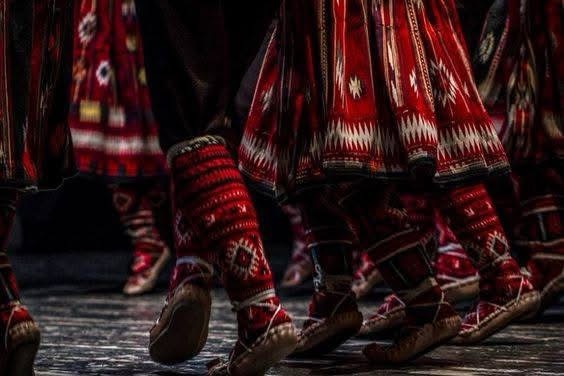
Central to this exploration is the Kolo, an embodied circle and/or Slavic folk round dance of social engagement. The word Kolopredates Sanskrit and means “the wheel,” symbolizing continuity, connection, and movement. The Kolo reflects the cyclical nature of healing and community, where collective practices create space for social restoration and adaptation.
Submission Guidelines:
We welcome submissions from scholars, practitioners, and activists across disciplines. Proposals for individual papers, panels, workshops, and artistic presentations should include:
1. Title of the paper or presentation
2. Abstract (300–500 words)
3. Author(s) name, affiliation, and contact information
4. Five keywords
Submission Deadline: May 15th, 2025
Notification of Acceptance: May 30th, 2025
Conference Dates: August 6th–9th, 2025
Location: Mt. Vlasic, Bosnia-Herzegovina (BiH)
Contact: For inquiries and submissions, please email [danica@kolocollaboration.org].
Join us in this vital conversation as we explore how memory can guide us from survival to thriving—transforming transgenerational trauma into pathways for healing, justice, and societal well-being.
Conference fees are on a sliding scale from $250-$195 and must be paid by July 4th. Registration does not include food, travel, transportation, or lodging. Discounted group rates are available at the hotel, please contact the hotel directly to arrange your lodging for the conference.
The Kolo:WCCC was founded by Dr. Danica Anderson from Olympia, Washington. Danica is a social scientist and clinical psychologist, who has travelled the world to bring healing to women in war zones in places like Bosnia, Sri Lanka, the Congo, Haiti, Afghanistan and more. Her work is rooted in a holistic approach within social collectives, and embodied trauma healing through cultural practices and bio culinary traditions. Building upon tacit women’s wisdom passed along generations, the potential to heal generational trauma is rooted in cultural practices and embodied in everyday small acts. Her work is designed where women become leaders and healers when they share their stories and culture in community.
 Kolo Memory In Motion